

Bayer stock achieves turnaround
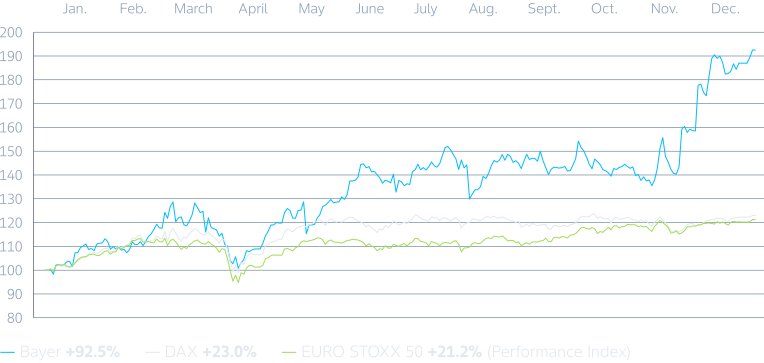
2025 was a year of surging stock performance for Bayer, which saw its share price rebound significantly from the historic low of €19.31 at year-end 2024 – the lowest level in over 20 years. The company’s stock closed at €37.01 per share on December 31, 2025, marking a significant 92.5% increase against the closing price a year earlier. The German stock index (DAX 40) and the EURO STOXX 50 were up 23.0% and 21.2%, respectively, over the same period. Bayer AG’s market capitalization increased by €17 billion to €36 billion.
Over the course of 2025, we made significant progress in delivering on our strategic priorities. These include driving growth and strengthening the pipeline at Pharmaceuticals, implementing Dynamic Shared Ownership, containing the litigations, and advancing our cash and deleveraging efforts, as the original four focus areas. Profitability at Crop Science was later added as a fifth strategic priority, with details shared during a webinar in May 2025.
Sell-side analysts adjusted their models and target prices in 2025. The average target price was €34.79 (as of the end of December 2025), compared to €27.70 a year earlier (as of the end of December 2024). Of the 19 analyst recommendations available for Bayer stock at the end of December 2025, nine were positive, nine neutral and one was negative (end of December 2024: three positive, 18 neutral and none negative).
The key drivers that propelled Bayer’s share price growth included the following:
Guidance upgrade: We raised our full-year outlook for the Group as a whole and the Pharmaceuticals Division in the summer of 2025, largely thanks to strong topline performance by Nubeqa™ and Kerendia™.
Asundexian: We achieved the primary efficacy and safety endpoints in the pivotal Phase III OCEANIC-STROKE trial investigating secondary stroke prevention in November 2025.
Progress in the glyphosate litigations: In December 2025, the US Solicitor General expressed support for a US Supreme Court review of the Durnell case.
Performance of Bayer stock in 2025
Indexed; 100 = Xetra closing price on December 31, 2024
|
|
|
|
2024 |
|
2025 |
|||||
|---|---|---|---|---|---|---|---|---|---|---|---|
Earnings per share from continuing and discontinued operations |
|
€ |
|
(2.60) |
|
(3.68) |
|||||
Core earnings per share from continuing operations1 |
|
€ |
|
5.05 |
|
4.91 |
|||||
Free cash flow per share |
|
€ |
|
3.16 |
|
2.12 |
|||||
Equity per share |
|
€ |
|
32.62 |
|
26.53 |
|||||
Dividend per share |
|
€ |
|
0.11 |
|
0.11 |
|||||
|
|
|
|
|
|
|
|||||
Year-end price2 |
|
€ |
|
19.31 |
|
37.01 |
|||||
High for the year2 |
|
€ |
|
35.60 |
|
37.01 |
|||||
Low for the year 2 |
|
€ |
|
18.87 |
|
18.99 |
|||||
|
|
|
|
|
|
|
|||||
Total dividend payment |
|
€ million |
|
108 |
|
108 |
|||||
Number of shares entitled to the dividend (Dec. 31) |
|
Shares (million) |
|
982.42 |
|
982.42 |
|||||
Market capitalization (Dec. 31) |
|
€ billion |
|
19.0 |
|
36.4 |
|||||
Average daily share turnover on German stock exchanges |
|
Shares (million) |
|
4.3 |
|
3.8 |
|||||
|
|
|
|
|
|
|
|||||
Price/EPS2 |
|
|
|
(7.4) |
|
(10.1) |
|||||
Price/core EPS2 |
|
|
|
3.8 |
|
7.5 |
|||||
Price/free cash flow2 |
|
|
|
6.1 |
|
17.4 |
|||||
Dividend yield 2 |
|
% |
|
0.6 |
|
0.3 |
|||||
|
|||||||||||
Dividend to remain at €0.11 as previously communicated
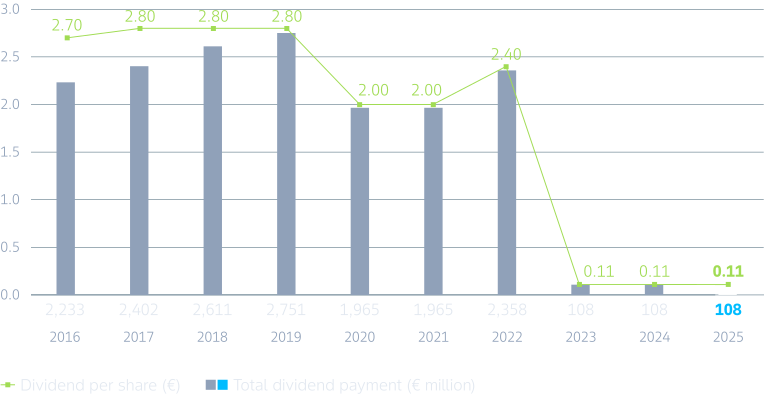
We amended our dividend policy for fiscal 2023, announcing that we planned to pay out the legally required minimum for three years. The Board of Management and the Supervisory Board will therefore propose to the Annual Stockholders’ Meeting that an unchanged dividend of €0.11 per share be paid out for 2025. The dividend proposal is geared toward supporting our company’s efforts to reduce debt. The dividend corresponds to 2.2% of 2025 core EPS (2024: 2.2%). Based on the Bayer share price at the end of 2025, the dividend yield is 0.3% (2024: 0.6%).
Dividends per share and total dividend payments
Bayer stock included in important indices
Bayer stock is listed on the DAX and numerous other key European indices, including the EURO STOXX 50, the FTSE Euro 100 and the S&P Europe 350. At the end of the year, Bayer was ranked 16th in the DAX 40 according to market capitalization. Bayer stock is also included in a number of sustainability indices, including FTSE4Good and MSCI Europe Low Carbon Leaders Index.
International ownership structure
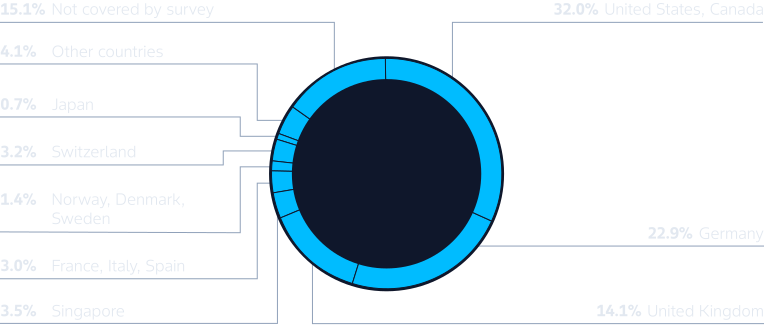
Our company’s global footprint is also reflected in our international ownership structure. The biggest share of our capital stock, at 32.0%, is held by investors in North America. German-based stockholders are also a key group of investors, holding 22.9% of Bayer stock, while shareholders in the United Kingdom account for 14.1%. Irrespective of geographical distribution, some 18% of our shares are held by private stockholders.
According to our share register, we had approximately 566,000 stockholders at the end of 2025.
Bayer has a 100% free float as defined by Deutsche Börse, the operator of the Frankfurt Stock Exchange.
Shareholder composition – regional allocation
Bayer steps up investor relations activities
Bayer management and the Investor Relations team maintained their close dialogue with analysts and investors in 2025. In addition to taking part in a host of investor conferences and roadshows, the Investor Relations team also participated in some 700 engagements in 2025, both in person and in virtual settings. The conversations focused on providing continuous updates on the progress being made with our strategic priorities and on the business performance of our three divisions.
After the positive experiences of recent years, we decided to hold our Annual Stockholders’ Meeting in a virtual format once again in 2025. As in the previous two years, stockholders effectively had the same rights as they would have had at an in-person Annual Stockholders’ Meeting. This included the ability to engage in direct dialogue with management during the Annual Stockholders’ Meeting through video communication, and the right to submit motions and election proposals as well as to make statements and ask questions. In addition, we have continued to refine the virtual format and also plan to explore and implement additional improvements in the future, with a particular focus on enhancing interaction with stockholders.
Due to these positive experiences, we intend to deploy this format again in 2026 and hold a virtual Annual Stockholders’ Meeting. Stockholders will have the same rights as they had at the 2025 event.
Sustainability: close dialogue with investors and ESG rating agencies
Last year, we maintained close dialogue with investors about the various aspects of sustainability at Bayer, with a focus on climate protection, biodiversity and regenerative farming; product stewardship, especially in crop protection; the progress made toward achieving our sustainability targets; and corporate governance.
At a webinar held in June 2025, we provided information on the latest developments related to our sustainability strategy. The discussions centered around the role of sustainability as a value driver in our divisions. Alongside bilateral investor discussions, we also engaged in targeted dialogue with individual investor groups in the context of collaborative engagements focusing on specific sustainability topics (such as Climate Action 100+, Nature Action 100, UNPRI Spring).
With regard to our ESG ratings, we attained further upgrades from MSCI Solutions, Sustainalytics, EcoVadis and CDP, and maintained our rating from ISS ESG. As such, our ESG rating profile is now even stronger that it was in previous years, with ratings that are on par with or above those of our peers.
Stable credit markets despite political uncertainty
Over the course of 2025, central banks reacted to stabilizing inflation rates in Europe and the United States by shifting away from the restrictive monetary policy employed in recent years and transitioning toward a more neutral form of monetary policy. Alongside inflation, the uncertainty triggered by the new trade policy announced in April by the US administration played a key role in this respect.
The European Central Bank lowered the deposit facility rate from 3.00% to 2.00% in four steps during the first six months of the year. By contrast, the US Federal Reserve did not begin to reduce interest rates until September. This cautious approach was due to difficulties in predicting the impact of higher US tariffs on local inflation, coupled with robust US labor market data indicating that there was no urgent need for action. Following three rate cuts in September, October and December, the US federal funds rate was in the 3.50% to 3.75% range at the end of the year.
The new global US tariffs announced in April only briefly impacted the degree of risk investors were willing to take, with markets recovering swiftly thanks to individual tariff agreements being struck with a number of trading partners and for a range of products. Central banks turning away from their restrictive monetary policy was also positively received, leading to a further narrowing of credit spreads on the bond markets for the remainder of the year.
Bayer capitalized on the positive environment and issued bonds in various markets to refinance financial liabilities falling due.
In January 2025, the company issued a Panda bond on the Chinese capital market, with a volume of CNY 2 billion, a maturity of three years and an interest rate of 2.4%. Another Panda bond was issued in July 2025 in two tranches. The first tranche has a volume of CNY 1 billion, a maturity of three years and an interest rate of 1.98%. The second tranche has a volume of CNY 1 billion, a maturity of five years and an interest rate of 2.23%.
In August 2025, Bayer issued a €400 million bond with a maturity of two years and a floating rate set at three-month Euribor plus 57 basis points, as part of a private placement.
In September 2025, Bayer AG tapped the Swiss bond market for the first time, issuing a bond with a total volume of CHF 265 million across two tranches. The first tranche has a volume of CHF 140 million, a maturity of five years and an interest rate of 1.075%. The second tranche has a volume of CHF 125 million, a maturity of nine years and an interest rate of 1.645%. By entering into additional markets, Bayer aims to diversify its investor base while at the same time capitalizing on attractive financing conditions.