

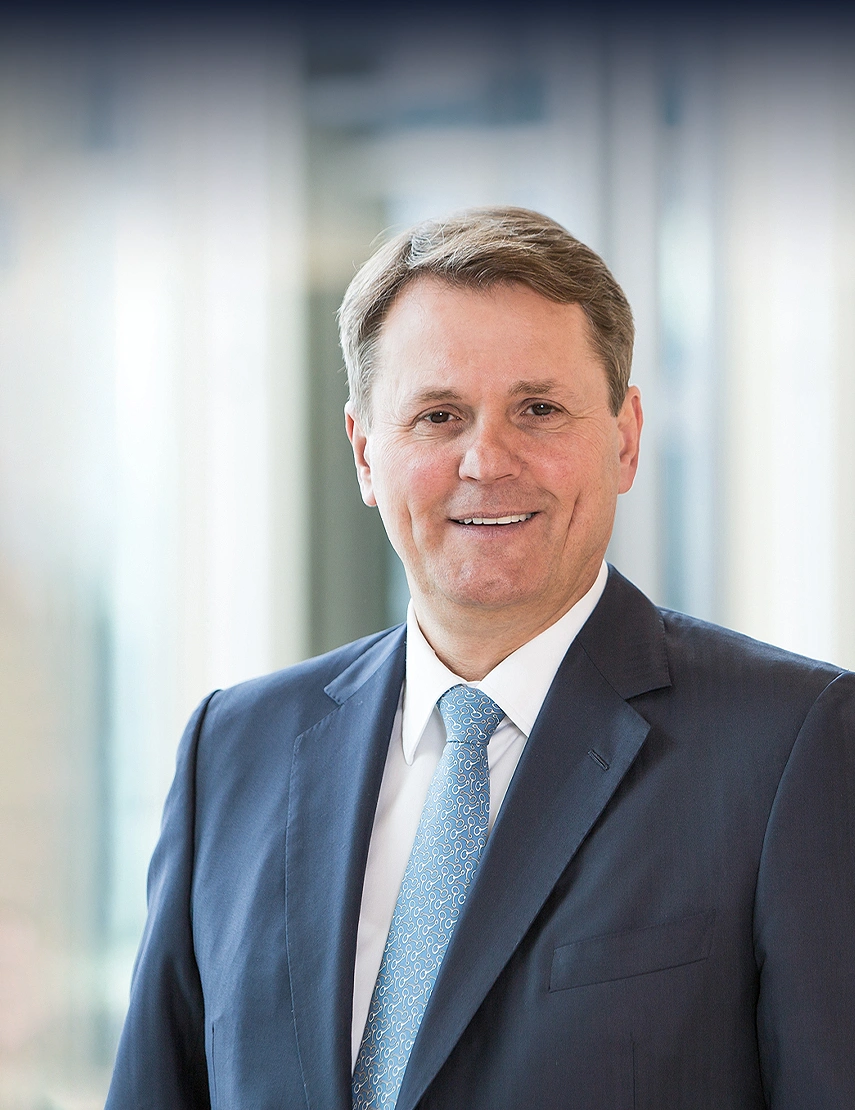

Fiscal 2025 was a year shaped by major geopolitical shifts that also significantly impacted Bayer. The company demonstrated resilience while continuing to advance along the path of transformation it has embarked upon. Against this backdrop, the Supervisory Board last year once again focused extensively on the company’s strategic alignment and the progress being made in delivering on the defined strategic priorities: the pharmaceuticals pipeline, containing the litigations, deleveraging, profitability in the Crop Science business, and reducing bureaucracy by systematically implementing the Dynamic Shared Ownership operating model. Among these strategic priorities, the company’s efforts to contain the ongoing litigations in the United States were a particular focal point of the Supervisory Board’s work. The Supervisory Board also had a number of decisions to make with regard to the composition of the Board of Management. These included extending the appointments of Bill Anderson, as Chairman of the Board of Management (CEO), and Stefan Oelrich, as member of the Board of Management and head of the Pharmaceuticals Division. The Supervisory Board also appointed Dr. Judith Hartmann to succeed outgoing CFO Wolfgang Nickl, who is set to leave the company at the end of May 2026. There was also a change on the Supervisory Board itself, with employee representative Nadine Dietz succeeding Dr. Barbara Gansewendt effective January 1, 2025.
Over the course of 2025, the Supervisory Board regularly monitored the conduct of the company’s business by the Board of Management and acted in an advisory capacity. This involved the Board of Management delivering comprehensive written and oral reports to the Supervisory Board based on the detailed set of information guidelines in place. In addition, the Chairman of the Supervisory Board maintained a constant exchange of information with the Chairman (CEO) and the other members of the Board of Management. Furthermore, the Chairman of the Supervisory Board and the Chairman of the Audit Committee were regularly in direct contact – including outside of the meetings – with the head of the Law, Patents, Insurance, Compliance and Data Privacy unit, the respective heads of Internal Audit and Risk Management, and the head of the Accounting and Taxes unit. The Chairwomen of the ESG Committee and the Legal Risk Committee were also regularly in direct contact with the respective specialist departments. This ensured that the Supervisory Board was kept continuously informed about the company’s intended business strategy, corporate planning (including financial, investment and human resources planning) and earnings performance, as well as the state of the business and the situation in the company and the Group, including the developments in the principal litigations.
Where Board of Management decisions or actions required the approval of the Supervisory Board, whether by law or under the Articles of Incorporation or the Rules of Procedure, the draft resolutions were reviewed by the Supervisory Board members, sometimes following preparatory work by the committees, and then approved during meetings of the full Supervisory Board or, in some cases, on the basis of documents circulated to the members. The Supervisory Board was involved in decisions of material importance to the company. We discussed at length the business trends described in the reports from the Board of Management and the development prospects for the Bayer Group as a whole as well as for the divisions and key markets.
Changes on the Supervisory Board
Employee representative Dr. Barbara Gansewendt retired on December 31, 2024, bringing to an end her service on the Supervisory Board. Nadine Dietz was elected to take her place, joining the Supervisory Board as an employee representative with effect from January 1, 2025.
Work of the Supervisory Board
The Supervisory Board convened for nine meetings in 2025, with the strategy meeting in September held across several days. The attendance rate of the individual Supervisory Board members at the meetings of the Supervisory Board and its committees is disclosed towards the end of this Report.
The meetings of the Supervisory Board were generally attended by members of the Board of Management. Each ordinary meeting formally includes an “executive session” at the beginning and end of the meeting during which no Board of Management members are present. Such sessions are included on the agenda as separate items. Ordinary Audit Committee meetings also include executive sessions that involve the Audit Committee consulting with the auditor without Board of Management members present.
The employee representatives and the stockholder representatives each held preparatory discussions prior to the ordinary meetings of the Supervisory Board.
The Supervisory Board Chairman took the opportunity to speak to investors about specific Supervisory Board matters during a corporate governance roadshow as well as on other occasions. These matters included the composition and compensation of the Board of Management, the composition of the Supervisory Board and other governance-related topics. A detailed overview of the topics discussed during the corporate governance roadshow can be found in the “Stockholder Presentation” on the website for the 2025 Annual Stockholders’ Meeting.
Matters discussed during the meetings of the full Supervisory Board and its committees, training events
The deliberations of the Supervisory Board in 2025 primarily related to the following topics, each of which was addressed at several Supervisory Board meetings: firstly, Bayer’s economic position and strategic alignment. The discussions around the company’s strategy also concerned the implementation of the Dynamic Shared Ownership operating model and the importance of technological developments such as the use of artificial intelligence (AI), including in the form of agentic AI. An additional focal point of the Supervisory Board’s work concerned the principal litigations, particularly relating to glyphosate and PCBs, which were extensively addressed by the full Supervisory Board, the Legal Risk Committee and the Audit Committee. The Chairman of the Supervisory Board and the Chairman of the Board of Management (CEO) as well as other members of the Board of Management also extensively discussed the aforementioned aspects outside of the meetings of the Supervisory Board and the respective committees.
At its individual meetings, the Supervisory Board mainly focused on the following topics and passed the following written resolutions:
At its February meeting, the Supervisory Board addressed the 2024 Annual Report, the Compensation Report and the Notice of the 2025 Annual Stockholders’ Meeting. It also took a close look at the Crop Science Division’s strategy and communication activities. At this meeting, the Supervisory Board received the regular risk report and discussed matters relating to Board of Management compensation, focusing particularly on target attainment and short-term variable compensation for 2024 and the targets for 2025. During this meeting, the Supervisory Board also extended Stefan Oelrich’s Board of Management appointment and service contract until October 31, 2029. In addition, the Supervisory Board examined the consequences arising from the settlement of a class action suit in California that had been filed against the company as well as active and former board members, and also addressed the glyphosate and PCB litigations. Finally, the Supervisory Board conducted special committee elections that were necessitated by the departure of Dr. Barbara Gansewendt and the election of Nadine Dietz to the Supervisory Board.
At its ordinary meeting ahead of the Annual Stockholders’ Meeting in April, the Supervisory Board looked at the company’s business performance to date. The Supervisory Board also discussed the principal litigations and potential containment options, as well as the upcoming Annual Stockholders’ Meeting.
At its ordinary meeting in June, the Supervisory Board addressed topics relating to Board of Management compensation, including a review of the updated Board of Management compensation system adopted in 2024. The Supervisory Board also conducted preparatory work for the planned extension of Bill Anderson’s appointment as Chairman of the Board of Management (CEO), and discussed the status of the search for a successor for the role of Chief Financial Officer (CFO). In addition, the Supervisory Board looked at the diversity and inclusion programs in place at Bayer and addressed the updated process for Board of Management succession planning and talent development. Lastly, the Supervisory Board engaged in extensive deliberations concerning the principal litigations.
At an extraordinary meeting in July, the Supervisory Board extended Bill Anderson’s appointment as Chairman of the Board of Management (CEO) as well as his service contract by three years until March 31, 2029.
At another extraordinary meeting in July, the Board of Management informed the Supervisory Board about planned settlements in the glyphosate and PCB litigations, and discussed the matter with the Supervisory Board.
By way of a written resolution in August, the Supervisory Board approved several financing measures.
As part of its strategy meeting in September, the Supervisory Board held two meetings and took part in a number of information events across three consecutive days. During the individual meetings, the Supervisory Board extensively focused on the performance of the Group, its three divisions and the enabling functions. The Supervisory Board also received input from specialist departments within Bayer and external legal advisors on managing the principal litigations and on the individual sub-projects focused on containing the principal litigations. In addition, the Supervisory Board learned about innovations within Bayer’s IT operations, including in particular opportunities for the use of agentic AI, and received insights on current geopolitical developments and the impacts they may have on Bayer. Lastly, the Supervisory Board resolved to propose to the Annual Stockholders’ Meeting that PricewaterhouseCoopers be appointed as auditor of the financial statements from fiscal 2027 in view of the auditor rotation requirements. The Supervisory Board also approved the acquisition of own shares for the purpose of implementing employee stock programs.
As part of the information events, the Supervisory Board travelled to the Pharmaceuticals site in Wuppertal to visit the division’s production facilities and laboratories and talk to employees working there. The Supervisory Board also spent time at Crop Science’s Monheim site, where it received a presentation on the current status of the division’s research and development pipeline and visited trial plots to learn about new products and R&D projects. The members of the Supervisory Board also met with managers and employees from the Leverkusen, Wuppertal and Monheim sites during an evening event.In September, the Supervisory Board approved the divestment of the Avalox™ business by way of a written resolution.
At an extraordinary meeting in November, the Supervisory Board appointed Dr. Judith Hartmann to the Board of Management with effect from March 1, 2026. She will subsequently succeed Wolfgang Nickl as CFO effective June 1, 2026. During this meeting, the Supervisory Board also resolved on the conclusion of a settlement in the US glyphosate litigation after receiving detailed information from internal and external legal advisors.
At its ordinary meeting in December, the Supervisory Board discussed the results of the efficiency audit, which had been conducted with external support, and agreed on ways to further improve the work of the Supervisory Board. In addition, the Supervisory Board received a preliminary status update on the target attainment levels for the variable components of Board of Management compensation. The Supervisory Board also resolved to amend its Rules of Procedure by raising the target age limit for members of the Board of Management from 63 to 65 in accordance with general developments and market practice. It discussed the company’s business performance and approved the operational planning for 2026. In addition, the Supervisory Board approved the scope of Bayer’s external financing and consented to the conclusion of a committed credit facility. Furthermore, the Supervisory Board once again closely looked at the principal litigations and containment options. It also discussed the composition of the stockholder base and aspects related to stockholder communication. Finally, the Supervisory Board resolved to issue the regular declaration of compliance with the German Corporate Governance Code.
In December, the Supervisory Board adopted a written resolution concerning the conclusion of a settlement in the PCB litigations.
Committees of the Supervisory Board
In 2025, the Supervisory Board had a Presidial Committee, an Audit Committee, a Human Resources and Compensation Committee, a Nomination Committee, a Legal Risk Committee and an ESG Committee.
The current membership of the committees is shown in the “D Further Information” section under “Governance Bodies”.
The meetings and decisions of the committees, and especially the meetings of the Audit Committee, Legal Risk Committee and ESG Committee, were prepared on the basis of reports and other information provided by the Board of Management. Reports on the committee meetings were presented at the meetings of the full Supervisory Board.
Presidial Committee: This committee comprises the Chairman and Vice Chairwoman of the Supervisory Board along with two further stockholder representatives and two further employee representatives. The Presidial Committee undertakes preparatory work for meetings of the full Supervisory Board and regularly meets prior to the ordinary meetings of the Supervisory Board. In addition, certain members of the Presidial Committee – the Chairman and Vice Chairwoman of the Supervisory Board, plus a designated stockholder representative and employee representative from this committee – also constitute the mediation committee pursuant to the German Codetermination Act (MitbestG). This mediation committee submits proposals to the Supervisory Board on the appointment of members of the Board of Management if the necessary two-thirds majority is not achieved in the first vote at a full Supervisory Board meeting. Furthermore, the Presidial Committee has been entrusted with certain decision-making powers in connection with capital measures, including the power to amend the Articles of Incorporation accordingly. The Supervisory Board can also delegate certain additional responsibilities to the Presidial Committee on a case-by-case basis.
The Presidial Committee convened for five meetings in 2025. During these meetings, it dealt with the next ordinary Supervisory Board meeting to be held. The Presidial Committee also deliberated on a number of additional topics: at a meeting in February, the Presidial Committee received a report on the investor conversations held by the Chairman of the Supervisory Board during the corporate governance roadshow. The Presidial Committee also reviewed the list of transactions requiring approval. At its April meeting, the Presidial Committee looked ahead to the upcoming Annual Stockholders’ Meeting and examined the progress made in appointing a successor to CFO Wolfgang Nickl when he steps down from the Board of Management. Lastly, the Presidial Committee reflected on the new approach to Supervisory Board training events that was introduced in the previous year, comprising four sessions per year, and looked ahead to the Supervisory Board efficiency audit that was to be conducted with external support. At its August meeting, the Presidial Committee discussed the status of the Supervisory Board efficiency audit. At its December meeting, the Presidial Committee considered the results of the Supervisory Board efficiency audit and the resulting recommendations. Following minor modifications, these recommendations were then put forward to the full Supervisory Board.
Over the course of 2025, the mediation committee was not required to exercise its role for any deliberations.
Audit Committee: The Audit Committee comprises four stockholder representatives and four employee representatives. The Chairman of this committee, Horst Baier, satisfies the statutory requirements concerning expertise in the field of accounting, and Supervisory Board Chairman Prof. Dr. Norbert Winkeljohann, who is also a member of this committee, satisfies the requirements concerning expertise in the field of auditing. Other members of the committee also have expertise in these areas. The Audit Committee holds five regular meetings each year.
Its tasks include, in particular, examining the financial reporting and monitoring the financial reporting process, the effectiveness and appropriateness of the internal control system and the risk management system, the effectiveness of the internal audit system, the compliance system and the audit of the financial statements. It also addresses relevant topics in the tax, finance and treasury areas. The Audit Committee prepares the resolutions of the Supervisory Board concerning the financial statements and Management Report of Bayer AG, the proposal for the use of the distributable profit, the Consolidated Financial Statements and the Management Report of the Bayer Group (including the mandatory CSR reporting). Further tasks include holding discussions with the Board of Management on the half-year financial reports and any quarterly reports or quarterly statements to be issued prior to their publication. The committee prepares the auditor selection process and submits a reasoned proposal to the Supervisory Board regarding the appointment of the auditor. It also prepares the agreements with the auditor (dealing in particular with the awarding of the audit contract, the determination of the main areas of focus for the audit, and the audit fee agreement) and takes appropriate measures to determine and monitor the auditor’s independence. The Audit Committee regularly assesses the quality of the audit and resolves on the approval of any other contracts awarded to the auditor, paying special attention to any potential implications for the auditor’s independence. The Audit Committee also discusses the assessment of the audit risk, the audit strategy and audit planning, and the audit results with the auditor. Furthermore, the Chairman of the Audit Committee regularly discusses the progress of the audit with the auditor and reports on this topic to the committee.
In addition, the Audit Committee monitors the internal process for assessing whether related-party transactions are executed in the ordinary course of business and on market terms. It resolves on behalf of the Supervisory Board on the approval of related-party transactions pursuant to Sections 111a to 111c and Section 107 of the German Stock Corporation Act (AktG) where such transactions require Supervisory Board approval and the Supervisory Board has not entrusted the approval decision to any other committee.
Committee meetings were regularly attended by the Chief Financial Officer, as well as in some cases by the Chairman of the Board of Management (CEO), too. However, neither of them were present for any of the executive sessions held at the beginning and end of each meeting. Representatives of the auditor were also present at all the meetings and reported in detail on the audit work and the audit reviews of the half-year report and quarterly statements. Every meeting includes executive sessions where the committee meets alone with the auditor, i.e. without Board of Management members present.
At each of its meetings, the Audit Committee discussed developments in legal and corporate compliance cases, where necessary, and the latest reports from Internal Audit.
The individual Audit Committee meetings also mainly focused on the following topics:
At the February meeting, the Audit Committee discussed the financial statements of Bayer AG and the Consolidated Financial Statements of the Bayer Group. It took a close look at the development of cash flow and capital expenditures in the Pharmaceuticals and Crop Science divisions. It also carefully considered the risk report, which covers the risk early warning system and other aspects, and the report on the internal control system (ICS). In addition, the Audit Committee dealt with the yearly compliance report and the developments in compliance and legal cases. Other matters addressed included the yearly report by Internal Audit, a report on the procedure for recording related-party transactions, as well as the independence of the auditor and the preparation of the proposal for the election of the auditor by the Annual Stockholders’ Meeting.
The May meeting focused on the quarterly statement for the first quarter. The committee also discussed a new approach for the planning process within the company, the quality of the audit of the financial statements, and the main areas of focus for the audit of the annual financial statements. Finally, the committee received a report on captive insurance activities at Bayer and discussed this matter.
At its August meeting, the Audit Committee mainly focused on the half-year financial report. The committee also discussed the effectiveness and further development of the risk management system and the internal control system for financial reporting. In addition, it looked at the status of the auditor selection process, with a new auditor needing to be appointed to review the financial statements from fiscal 2027 due to the auditor rotation requirements. The committee also discussed the accelerated processes and timelines for preparing the 2025 financial statements compared with 2024. Other topics addressed included an update on data security and cybersecurity, as well as scenarios involving the company’s financing in 2026 and beyond.
At its November meeting, the Audit Committee extensively discussed the quarterly statement for the third quarter and the audit budget for the auditor of the financial statements.
At its December meeting, the Audit Committee examined the status of the strategic business plan for 2026, the yearly reports of the Treasury and Taxes function, aspects related to ESG reporting, the audit planning by Internal Audit and the future implementation of IFRS 18. The meeting also covered the annual planning of the Audit Committee for 2026 and the topics of data security and cybersecurity, with the discussion also taking into account opportunities and risks arising from artificial intelligence.
Human Resources and Compensation Committee: The Human Resources and Compensation Committee has six members, with parity of representation between stockholders and employees. It prepares the personnel decisions of the full Supervisory Board, which resolves on appointments or dismissals of members of the Board of Management, and monitors the development of Board of Management compensation on an ongoing basis. The committee also resolves on the service contracts of the members of the Board of Management, acting on behalf of the Supervisory Board. However, the full Supervisory Board is responsible for resolving on the total compensation of the individual members of the Board of Management, the respective compensation components and the compensation system, as well as for regularly reviewing the compensation system on the basis of recommendations submitted by the Human Resources and Compensation Committee. The Human Resources and Compensation Committee also discusses the long-term succession planning for the Board of Management.
The Chairman of the Board of Management (CEO) regularly attended the meetings of the Human Resources and Compensation Committee where the matters discussed did not relate to him personally.
The Human Resources and Compensation Committee convened for seven meetings. The meetings focused on the extension of Stefan Oelrich and Bill Anderson’s appointments to the Board of Management until October 31, 2029, and until March 31, 2029, respectively. During several meetings, the committee discussed whether modifications needed to be made to the current Board of Management compensation system, which had been approved at the 2024 Annual Stockholders’ Meeting, and deliberated on ways to enhance compensation reporting. In addition, a number of meetings involved the committee conducting preparatory work to support the search for a new CFO, culminating in the committee recommending that the Supervisory Board appoint Dr. Judith Hartmann to the role. The corresponding Supervisory Board resolution was subsequently adopted in November 2025. Other topics included succession planning for the Board of Management, the diversity and inclusion programs in place at Bayer, the standards for medical check-ups for Board of Management members, and possible changes to the existing age limits for members of the Board of Management. Finally, the committee prepared the Supervisory Board resolutions on the performance evaluations for fiscal year 2024, the targets for fiscal year 2025 and a review of base compensation for Board of Management members.
Nomination Committee: This committee carries out preparatory work when an election of stockholder representatives to the Supervisory Board is to be held. It suggests suitable candidates for the Supervisory Board to propose to the Annual Stockholders’ Meeting for election. The committee comprises the Chairman of the Supervisory Board, who serves as its Chairman, and three further stockholder representatives.
The Nomination Committee convened three times in 2025. At these meetings, it prepared the Supervisory Board elections to be conducted at the 2026 Annual Stockholders’ Meeting in view of two members coming to the end of their terms of office, and also looked at long-term succession planning for the Supervisory Board.
ESG Committee: The ESG Committee consists of the Chairman of the Supervisory Board and seven other members, with parity of representation between stockholders and employees. It deals with sustainable corporate governance and the company’s business activities in the areas of environmental protection, social issues and corporate governance (ESG). This mainly pertains to the way sustainability is incorporated into the business strategy; the establishment of sustainability targets; nonmandatory ESG reporting and the auditing thereof, if applicable; opportunities and risks; and organizational structures and processes in ESG areas, provided the Audit Committee is not already responsible for these matters. Within its area of responsibility, the committee advises and oversees management and prepares any Supervisory Board decisions to be made.
The ESG Committee convened four times in 2025.
At its February meeting, the committee discussed Bayer’s sustainability performance in 2025, the Sustainability Statement, the ESG ratings and the ESG targets for the variable compensation of the Board of Management, and the ESG mission and visions of the three divisions. Additional areas of focus were the sustainability strategy and the geopolitical situation.
At its meeting in May, the committee discussed future sustainability reporting, the sustainability strategy of the Consumer Health Division, the target attainment status for the ESG targets, and the strategic partnership with the World Bank.
At its August meeting, the committee examined the progress made in implementing the sustainability targets and discussed the new composition and realigned work of Bayer’s Sustainability Council. The committee also took a close look at the Crop Science Division’s sustainability strategy. Other topics included a review of the double materiality assessment for the purposes of sustainability reporting, and an update on the implementation of the sustainability strategy.
At its November meeting, the committee looked at ways to reduce the environmental impacts of crop protection products, and also discussed carbon markets, regulation and legal risks relating to PFAS, and the topic of human rights.
Legal Risk Committee: The Legal Risk Committee consists of the Chairman of the Supervisory Board and seven other members, with parity of representation between stockholders and employees. The chairperson of the committee is elected by the Supervisory Board. The committee coordinates the respective activities in which the Supervisory Board exercises its rights and fulfills its duties with regard to all processes in the company and the Group relating to ongoing or pending regulatory and legal proceedings in all branches of the court system in Germany and around the world that are of substantial importance for the company and/or the Group (hereinafter referred to as “legal risks”), as well as measures to resolve, avert or contain these legal risks. The Supervisory Board can delegate further duties to the committee, including exercising the Supervisory Board’s participation rights with regard to the aforementioned tasks in individual cases or for certain groups of cases. The Chairman of the Board of Management (CEO) and the Chief Financial Officer regularly attend the committee meetings.
The committee convened four times in 2025, with the meetings taking place in February, June, August and December. At each of these meetings, the committee dealt with the status of the principal litigations involving glyphosate and PCBs in the United States, as well as with containment strategies. The committee prepared any resolutions that were necessary in connection with these matters. The meetings were also attended by external legal advisors to the company and by representatives of the law firm Linklaters, which the Supervisory Board has commissioned to act as its independent legal counsel in this matter. The meetings were also widely attended by Supervisory Board members who were not members of the committee and opted to take advantage of the opportunity to take part as guests.
Training events: The Supervisory Board held four training events in 2025 that covered the use of artificial intelligence in the work of the Supervisory Board, climate policy and human rights, cell and gene therapy, and research and development in the Consumer Health Division.
Corporate governance
The Supervisory Board considered the principles of corporate governance at Bayer. It mainly addressed this topic at its December meeting, during which it dealt with the declaration of compliance with the German Corporate Governance Code and resolved to amend its Rules of Procedure by adjusting the target age limits for Board of Management members. During the Supervisory Board meetings, the Chairman of the Supervisory Board also summarized the dialogue he had engaged in with investors during investor discussions in January, February and April, as well as during a number of individual conversations. The topics included Board of Management compensation, the composition of the Supervisory Board and other governance-related matters in connection with the 2025 Annual Stockholders’ Meeting.
Disclosure of meeting attendance
The members’ attendance rate for the meetings of the full Supervisory Board and the committees was around 93%.
The Supervisory Board and its committees conduct some of their meetings in person, while the others are held either virtually as video conference calls or in a hybrid format in order to facilitate modern, more sustainable meeting formats. Individual participants were sometimes allowed to attend in-person meetings virtually. None of the meetings took place as a telephone conference call. Of the nine meetings held by the Supervisory Board, four were conducted in person and the others were held virtually. Of the 28 committee meetings in total, 10 were held in person and the others were conducted virtually or as hybrid meetings.
The participation of the individual Supervisory Board members in the meetings of the Supervisory Board and its committees is shown below:
|
|
Supervisory |
|
Audit |
|
Human |
|
ESG |
|
Nomination |
|
Legal Risk |
|
Presidial |
||||||||||||||
|---|---|---|---|---|---|---|---|---|---|---|---|---|---|---|---|---|---|---|---|---|---|---|---|---|---|---|---|---|
|
|
(9, of which 4 |
|
(5, of which 2 |
|
(7, of which 2 |
|
(4, of which 1 |
|
(3, of which 1 |
|
(4, of which 2 |
|
(5, of which 2 |
||||||||||||||
Number of |
|
Number |
|
% |
|
Number |
|
% |
|
Number |
|
% |
|
Number |
|
% |
|
Number |
|
% |
|
Number |
|
% |
|
Number |
|
% |
Prof. Dr. Norbert Winkeljohann |
|
9/9 |
|
100 |
|
5/5 |
|
100 |
|
7/7 |
|
100 |
|
4/4 |
|
100 |
|
3/3 |
|
100 |
|
4/4 |
|
100 |
|
5/5 |
|
100 |
Heike Hausfeld |
|
8/9 |
|
89 |
|
4/5 |
|
80 |
|
6/7 |
|
86 |
|
2/4 |
|
50 |
|
|
|
|
|
3/4 |
|
75 |
|
5/5 |
|
100 |
Dr. Paul Achleitner |
|
9/9 |
|
100 |
|
|
|
|
|
|
|
|
|
|
|
|
|
|
|
|
|
4/4 |
|
100 |
|
3/5 |
|
60 |
Horst Baier |
|
9/9 |
|
100 |
|
5/5 |
|
100 |
|
7/7 |
|
100 |
|
|
|
|
|
|
|
|
|
|
|
|
|
|
|
|
André van Broich |
|
9/9 |
|
100 |
|
|
|
|
|
7/7 |
|
100 |
|
3/4 |
|
75 |
|
|
|
|
|
4/4 |
|
100 |
|
|
|
|
Ertharin Cousin |
|
9/9 |
|
100 |
|
|
|
|
|
|
|
|
|
4/4 |
|
100 |
|
|
|
|
|
|
|
|
|
|
|
|
Nadine Dietz |
|
8/9 |
|
89 |
|
4/4 |
|
100 |
|
|
|
|
|
|
|
|
|
|
|
|
|
|
|
|
|
3/4 |
|
75 |
Yasmin Fahimi |
|
8/9 |
|
89 |
|
|
|
|
|
|
|
|
|
3/4 |
|
75 |
|
|
|
|
|
|
|
|
|
|
|
|
Colleen A. Goggins |
|
9/9 |
|
100 |
|
|
|
|
|
|
|
|
|
4/4 |
|
100 |
|
2/3 |
|
67 |
|
|
|
|
|
|
|
|
Francesco Grioli |
|
7/9 |
|
78 |
|
|
|
|
|
|
|
|
|
|
|
|
|
|
|
|
|
|
|
|
|
5/5 |
|
100 |
Frank Löllgen |
|
7/9 |
|
78 |
|
4/5 |
|
80 |
|
|
|
|
|
|
|
|
|
|
|
|
|
2/4 |
|
50 |
|
|
|
|
Marianne Maehl |
|
8/9 |
|
89 |
|
|
|
|
|
|
|
|
|
|
|
|
|
|
|
|
|
|
|
|
|
|
|
|
Kimberly Mathisen |
|
9/9 |
|
100 |
|
|
|
|
|
|
|
|
|
4/4 |
|
100 |
|
3/3 |
|
100 |
|
|
|
|
|
|
|
|
Andrea Sacher |
|
9/9 |
|
100 |
|
|
|
|
|
7/7 |
|
100 |
|
|
|
|
|
|
|
|
|
4/4 |
|
100 |
|
|
|
|
Claudia Schade |
|
9/9 |
|
100 |
|
|
|
|
|
|
|
|
|
4/4 |
|
100 |
|
|
|
|
|
|
|
|
|
|
|
|
Lori Schechter |
|
9/9 |
|
100 |
|
5/5 |
|
100 |
|
|
|
|
|
|
|
|
|
|
|
|
|
4/4 |
|
100 |
|
|
|
|
Dr. Nancy Simonian |
|
9/9 |
|
100 |
|
|
|
|
|
7/7 |
|
100 |
|
|
|
|
|
|
|
|
|
|
|
|
|
|
|
|
Jeffrey Ubben |
|
8/9 |
|
89 |
|
5/5 |
|
100 |
|
|
|
|
|
|
|
|
|
|
|
|
|
4/4 |
|
100 |
|
|
|
|
Alberto Weisser |
|
9/9 |
|
100 |
|
|
|
|
|
|
|
|
|
|
|
|
|
3/3 |
|
100 |
|
|
|
|
|
4/5 |
|
80 |
Michael Westmeier |
|
9/9 |
|
100 |
|
5/5 |
|
100 |
|
|
|
|
|
|
|
|
|
|
|
|
|
|
|
|
|
|
|
|
Financial statements and audits
The financial statements of Bayer AG were prepared according to the requirements of the German Commercial Code (HGB) and Stock Corporation Act (AktG). The Consolidated Financial Statements of the Bayer Group were prepared according to the IFRS® Accounting Standards as endorsed by the European Union. The applicable further requirements of Section 315a of the German Commercial Code (HGB) were also taken into account. The Combined Management Report was prepared according to the German Commercial Code (HGB).
The auditor, Deloitte GmbH Wirtschaftsprüfungsgesellschaft, Munich, has audited the financial statements of Bayer AG, the Consolidated Financial Statements of the Bayer Group and the Combined Management Report. The auditor responsible for the audit was Silvia Geberth, who signed the Independent Auditor’s Report for the first time for the year ended December 31, 2024. The conduct of the audit is explained in the auditor’s reports. The auditor finds that Bayer has complied, as appropriate, with the German Commercial Code (HGB), the German Stock Corporation Act (AktG) and/or the IFRS® Accounting Standards endorsed by the European Union, and issues an unqualified opinion on the financial statements of Bayer AG, the Consolidated Financial Statements of the Bayer Group and the Combined Management Report. The financial statements of Bayer AG, the Consolidated Financial Statements of the Bayer Group, the Combined Management Report and the audit reports were submitted to all members of the Supervisory Board. They were discussed in detail by the Audit Committee and at a meeting of the full Supervisory Board. The auditor submitted a report on both occasions and was present during the discussions.
We examined the financial statements of Bayer AG, the proposal by the Board of Management for the use of the distributable profit, the Consolidated Financial Statements of the Bayer Group and the Combined Management Report. While examining the Combined Management Report, we also examined in particular the combined nonfinancial statement, which is based on the framework of the European Sustainability Reporting Standards (ESRS) and was subjected to a limited assurance review by the external auditor. We have no objections, and thus we concur with the result of the audit.
We have approved the financial statements of Bayer AG and the Consolidated Financial Statements of the Bayer Group prepared by the Board of Management. The financial statements of Bayer AG are thus confirmed. We are in agreement with the Combined Management Report and, in particular, with the assessment of the future development of the enterprise. We also concur with the dividend policy and the decisions concerning earnings retention by the company. We assent to the proposal by the Board of Management for the use of the distributable profit, which provides for payment of a dividend of €0.11 per share.
The Supervisory Board would like to thank the Board of Management and all employees for their dedication and hard work in 2025.
Leverkusen, March 3, 2026
For the Supervisory Board
Prof. Dr. Norbert Winkeljohann
Chairman